
Adhesion
Design Recommendations for Adhesion:
(Bralla, "DESIGN FOR MANUFACTURABILITY Handbook")
1. Design for shear, tension, and compression, not cleavage or peel. Adhesive bonds resist shear, tensile, and compressive forces better than cleavage or peel. Thus the designs shown in Fig. 7.5.2b are preferable to those of Fig. 7.5.2a.
2. The width of the joint overlap is more important than its length. Bond strength is not proportional to bond area except in cases of pure tension and compression. In a lap joint loaded in shear, the stresses are concentrated at the bond ends. Joint strength therefore is increased more by widening the joint than by lengthening it.
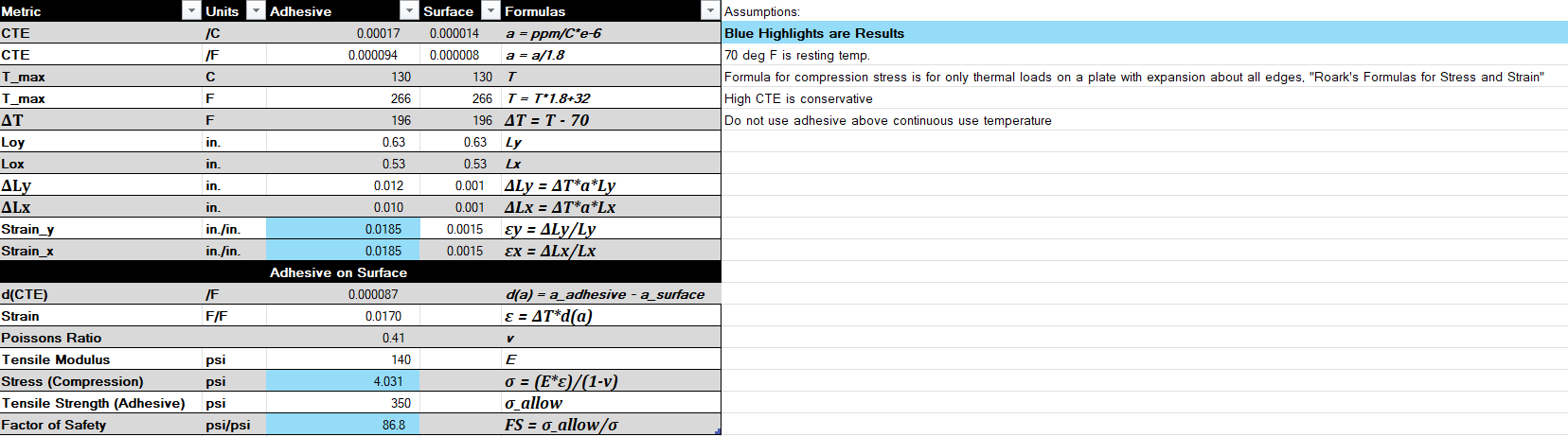
3. Match expansion coefficients. Large shear stresses are generated when materials with different thermal expansion coefficients are thermally cycled after bonding. Ideally, an adhesive should have an expansion coefficient midway between those of the adherends. Plastics-to-metal bonds may be a problem because of the large differences in thermal expansion of these materials. Fillers are often added to an adhesive to control (usually reduce) its coefficient of expansion. Faster heat-up rates may be possible when the expansion behavior of the adhesive is close to that of the parts.
4. Thin bond lines are preferred. A thin layer of adhesive is usually advantageous; 25 µm (0.001 in) is typical; thick glue lines consume excess adhesive, have a statistically greater chance for cracks and voids, and do not respond as quickly to temperature changes. An exception would occur when high-impact strength is desired. Then a thicker, more flexible adhesive might well be preferred.
5. Design for easy cleaning. Dirty surfaces are a major cause of poor joint performance. Vapor degreasing is a preferred method of preparing surfaces. Solvent wiping may be sufficient if the wipe rags are not allowed to become dirty. Dip cleaning is risky because of the possibility of gradual or sudden contamination of the dip tanks. (See Chap. 8.1 for information on designing parts for easy cleaning.)
6. Smooth surfaces are preferred. Smooth surfaces are more easily wet by a spreading liquid adhesive. A greater percentage of the area of part surfaces can contact the adhesive when each surface is smooth. Surfaces are often roughened by abrasive treatment before bonding to remove loosely held surface material, even though surface contact with the adhesive is thereby reduced. Loosely held surface layers are the greater evil.
7. Simple butt joints should be used only when fairly large bond surfaces are involved and when cleavage stresses are not anticipated. Figure 7.5.3 illustrates some of the ways in which a butt joint can be modified to increase resistance to cleavage failure.
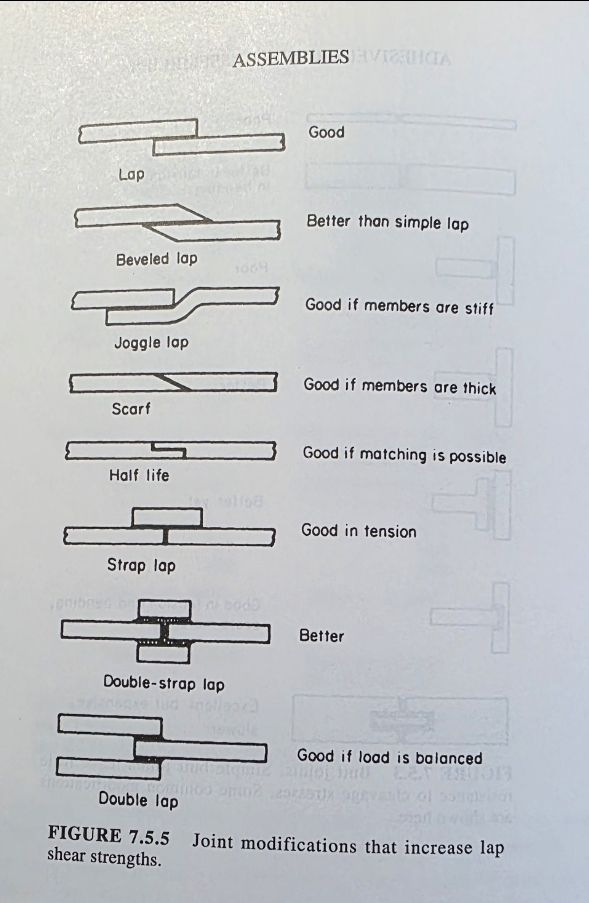
8. When simple lap joints are stressed in tension, they tend to deform as shown in Fig. 7.5.4. This deformation introduces cleavage stresses (for rigid adherends) or peel stresses (for flexible adherends) at the joint ends. Commonly used designs to minimize these stresses are shown in Fig. 7.5.5.
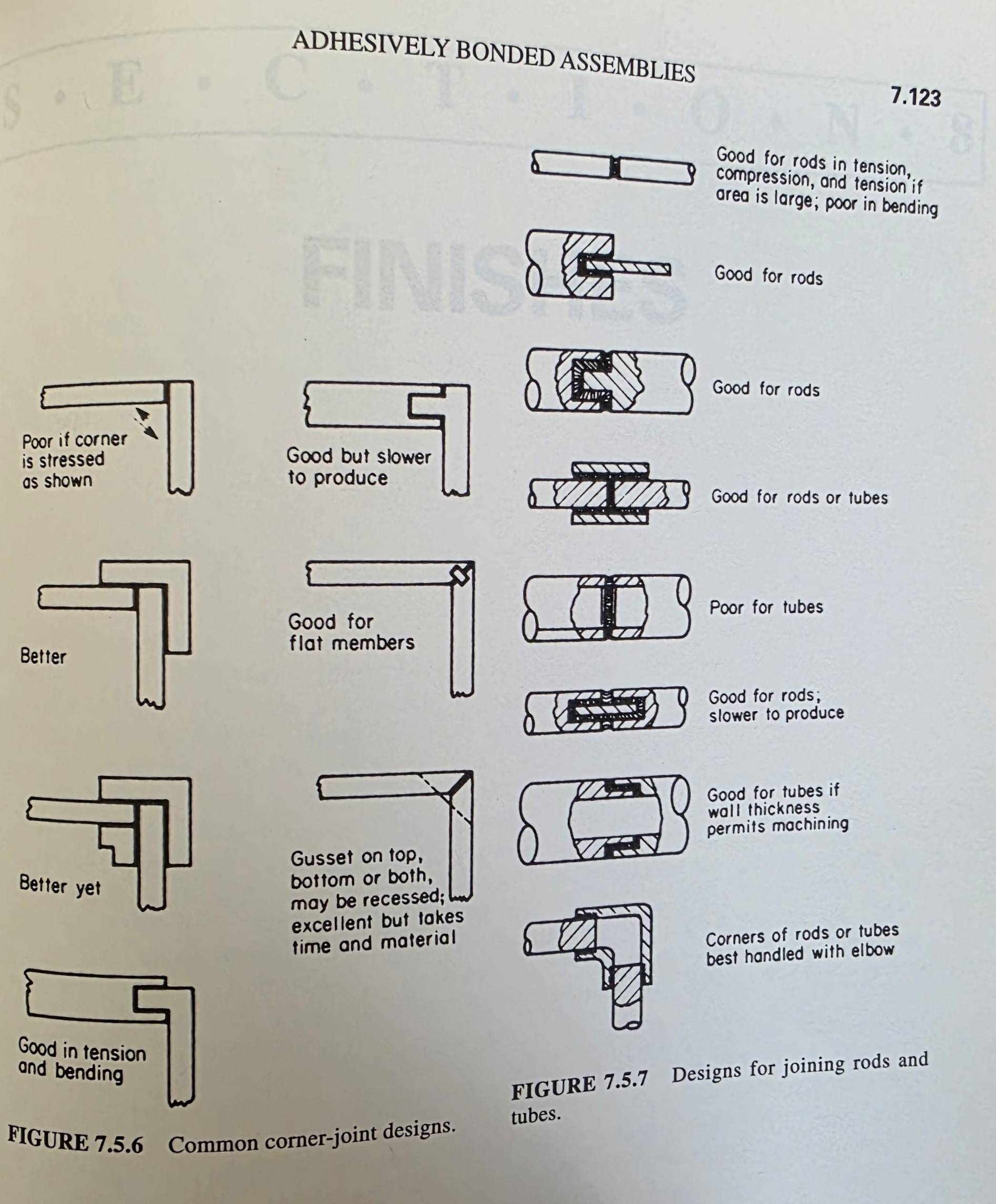
9. Corner joints involving members of various thicknesses are shown in Fig. 7.5.6. Many variations are possible. The preferred design is usually the one that involves machining or forming operation is offset by the easier cleaning or assembly meth-the least preparation (including handling) cost. Sometimes the cost of an extra ods that may then be possible.
10. Figure 7.5.7 depicts a number of common techniques for joining rods and tubes adhesively. That design is best which requires the least machining and assembly time. Corners are usually best handled with elbows.
Max Acceleration in G:
(Roark's Formulas for Stress and Strain)

CTE Mismatch via all edge constraint:
(Roark's Formulas for Stress and Strain)
Resource for reviewing adhesion: https://www.stevenabbott.co.uk/practical-adhesion/