Composite All-In-One
Intro:
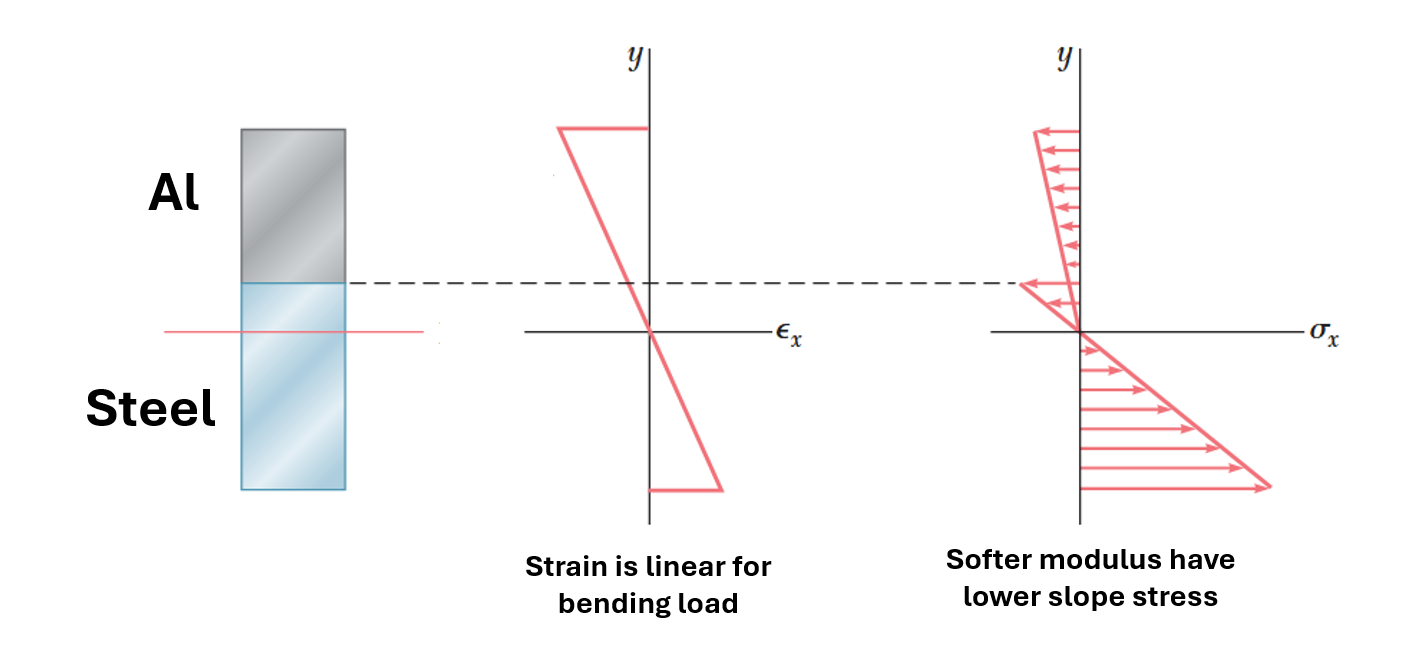
Composite materials are core to how we make lightweight long term parts on the car. At a fundamental level, composite materials are what they sound like, mixed materials. This comes mixed mechanical behavior and varying failure modes not typical of homogenous materials.
- Modulus of elasticity: for softer materials, lower modulus materials, will have less stress than those of hard materials
- Poissons ratio (dilation effects): the primary concern for debonding the two materials
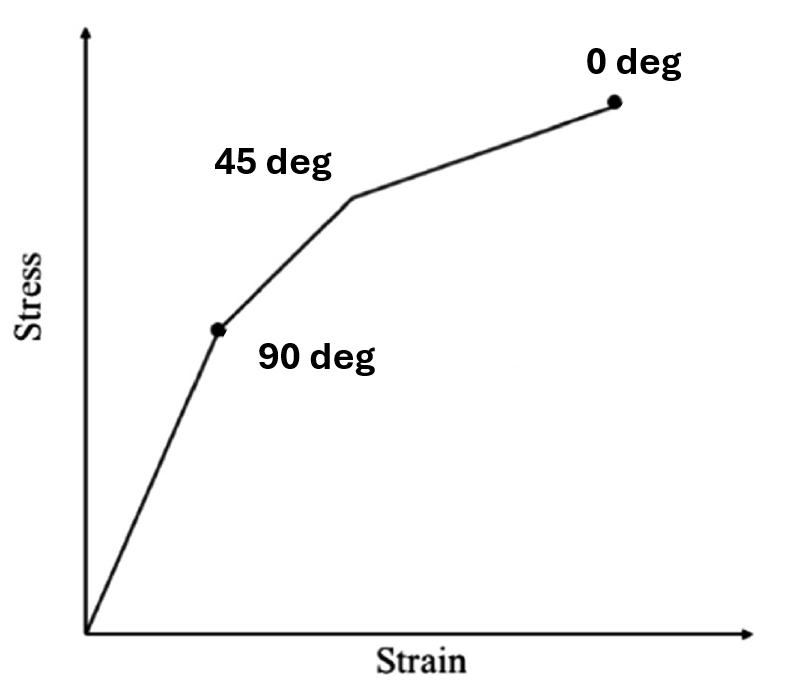
- Strength: materials can break resulting a nonlinear stress-strain curve
- Failure modes: debonding becomes a failure mode.
The choice to use composites over metallic components is a common debate and usually comes down a couple issues with composites:
Pros:
- Very low weight for how strong it is
- Can behave as rigid bodies due to psudo-brittle behavior
- Complex mechanical behavior can allow for high amounts of customized behavior
- Can be used for "quick" repair of parts
Con:
- Complex failure modes
- Loads should be specific
- Manufacturing is unconventional and sometimes difficult to replicate expected behavior
- Behavior is complex and hard to define
- First principles are hard to integrate well and not taught much in school
This page will go over how to think, design, analyze, and manufacture with composites.
Think:
Traditional composites are more common in civil engineering, think concrete and rebar. Our club primarily does polymer composite work with thin glass, kevlar, or carbon fiber, which are more common in mechanical/aerospace applications. "Composites" will from now on be in reference to GFRP or CFRP, glass fiber reignforced polymer or carbon fiber reignforced polymer. The two components of composites are the fibre and matrix, the fibre contains the material strength and the matrix is the medium that the load is exchanged. The matrix is usually a elastic polymer and fibre is usually a brittle glass or graphite. Another way to think about it is, graphite fibre lack transverse strength that make them break immediatly upon off-axis loads that gets compenated for by the matrix, this can be seen in the figure below. The fibre generates most of the modulus and strength, the matrix accounts to off-axis loading.
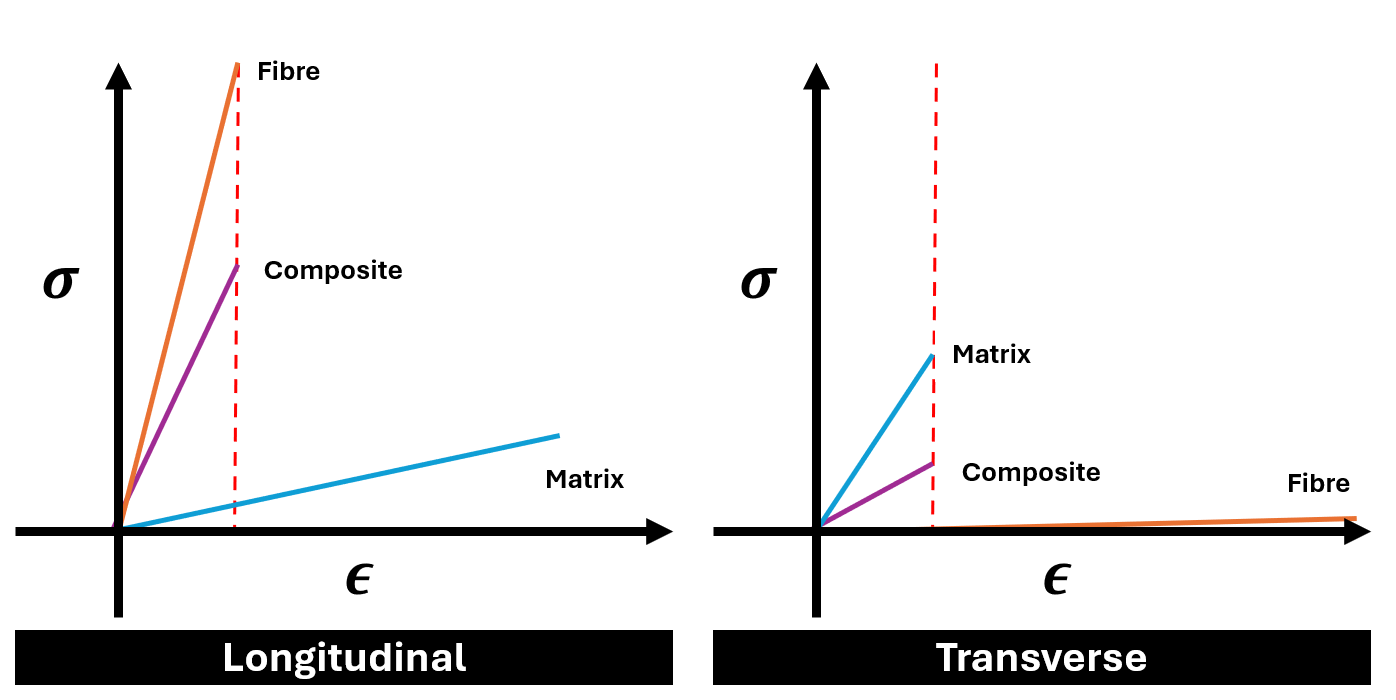
For a uni-directional fabric, fabric where the fibre only go in one direction, 88.5% of the total potential stiffness is in the longitudinal/fibre direction, 5.25% in the transverse direction, and 1.6% is shear stiffness. These charactertics follow with textiles fabrics, plain weave is 44.5% for longitudinal and transverse directions.
First-Principles:
Basics:
These are the first-order principles to give some basis of understanding for how to work with and talk about composites.
Fibre reinforced polymers are used for in-plane tensile and bending loads. Out-of-plane loads are compensated by core, typically. The combination of core and facesheet are called "Sandwich Panels." Face sheet carrys all inplane loads (A & D), while the core provides shear continunity, so sandwich acts as unit for reisting bending loads (both faces act together). The most common fibres, matrices, and cores are seen below.
Common fibres include:
- Carbon - common for structural applications. Stiffness can vary between grades. T300 is the lowest stiffness grade and T1000 is the highest, higher stiffness does not mean stronger. Comes in uni-directional and textile fabrics. Textiles include plain weave, twill, satin, and a bunch of other ones. Carbon is graphite and is on the opposite side of the galvanic chart to aluminum, corrodes alumnimum and needs either glass, paint, or some film to prevent corrosion.
- E-glass - used in PCBs and for higher strain loads. It's cheaper and heavier than carbon. It can be dyed to change color and is clear when laminated. Commonly used over fillets for increased strength, minimal stiffness, and clear to see if cracks are forming. It is called soft due to it's lower modulus, not a bad characteristic.
- S-glass - structural glass fibre used for structural applications when carbon can't be used. Great for fillet where E-glass can't. Does not corrode with aluminum.
- Kevlar - only for structural application in tension, doesn't conduct heat, but is expensive and horrible to cut. Avoid if possible.
Common matrices include:
- Epoxy - Most common matrix used. Common for structural loads, breaks like glass but is very elastic. Clear so it can be dyed. There are high thermal variates. Does not have much warpage, making it the easiest to use. Expensive depending on the seller and purpose.
- Polyester - Common for mold use due to it being cheap. High degrees of warpage and is very weak. Do not use for structures.
- Phenolic - Common for high heat use. Releases film when heated up that prevents heat transfer. Not common for solar car, only used for space stuff sometimes.
Common textile farbic forms include:
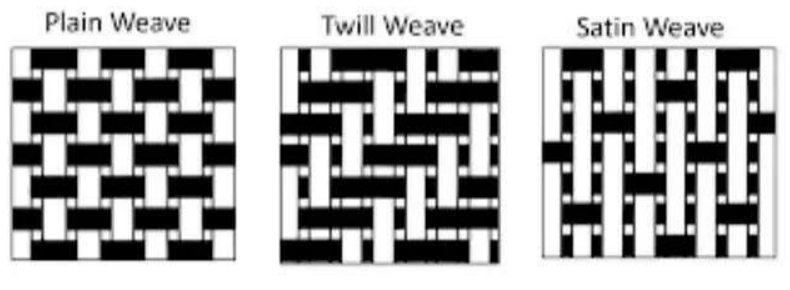
- Plain weave is the easiest to model and think about, but can be hard to drap along large curvatures for molds. Can be slightly more expensive than twill.
- Twill is the cheapest variant and acts the same as plain weave in macro-scale, but is hard to model in meso-scale. Easy to drap over large curvatures. Probably the most common fabric used.
- Satin is a weird one that used primarily for very specific curvatures, can be very difficult to model in meso-scale, but is do-able.
Common Cores include:
- Aramid Honeycomb (Nomex) - Lightweight and stiff, common for structural application. Can be hard to bend around curves, so usually requires slits to slide to make a bend. The honeycomb is not the same in both directions, one direction is more compliant than the other, has a sort of auextic behavior.
- Alumnimum Honeycomb - Lightweight and stiff, common for structural application. Easy to bend around curves. Susceptible to corrosion.
- Divinycell (Foam) - Lightweight and mildy stiff, common for suplemental structural application. Can come with slits for infusion, resin flow. Should be worried about epoxy being sucked into the core too much when manufacturing.
- Rohacell (Foam) - Lightweight and stiffer than Divinycell, common for structural application. Sort of stat buffed Divinycell.
- Wood - It's used, but not often. Can be heavy, but is valid when desperate. Very strong and heavy.
- Plastic Honeycomb - Cheap and is core when desperate.
Sandwich Panels:
Normal stress is assumed to occur in the facesheets only and uniform across thickness. Shear stress is assumed to occur only in core and uniform in the core. Pros and cons for sandwich panels are:
Pros:
- Very light weight
- Verty high flextural rigidity
- Geat thermal insulation
Cons:
- No acoustic insulation
- Fire resistence not good
- buckling sucks. Compression reistence is limited by ciritical values, which depends on how the type of load determining buckling mode.
Facesheet failure modes include:
- Tension - rupture from tension and bending
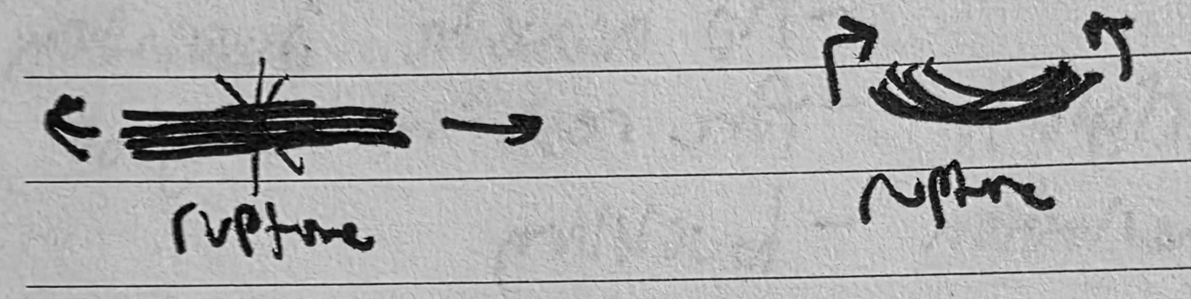
- Compression - delamination or buckle wrinkling

- Shear - delamination

Sandwich panel failure modes include, the ones in bold are the ones I see the most often:
- Facesheet ultimate strength - face sheet yields tension
- Bending stress -face sheet yields bending
- Shear crimpling - local failure, caused by low density core, abrupt shear failure from axial buckling load (load basis)
- Facesheet wrinkling - local, low bending stiffness of facesheet and core, higher stiffness increases buckling mode. characterized by depression or debonding in facesheet (stress basis).
- Facesheet dimpling - local, influenced by bending stiffness of facesheet relative to unsupported dimension. Only honeycomb, characterized by dimpling (stress basis).
- Column buckling - euler buckling, covers alot of the failure modes but general buckling also occurs. Occurs from non-sufficient bending stiffness, D. First-order view is EI = Db, flextural stiffness = bending stiffness * thickness. Where the critical load is k*pi^2*(Db/L^2)
- Core shear strength - Core shear stress failure
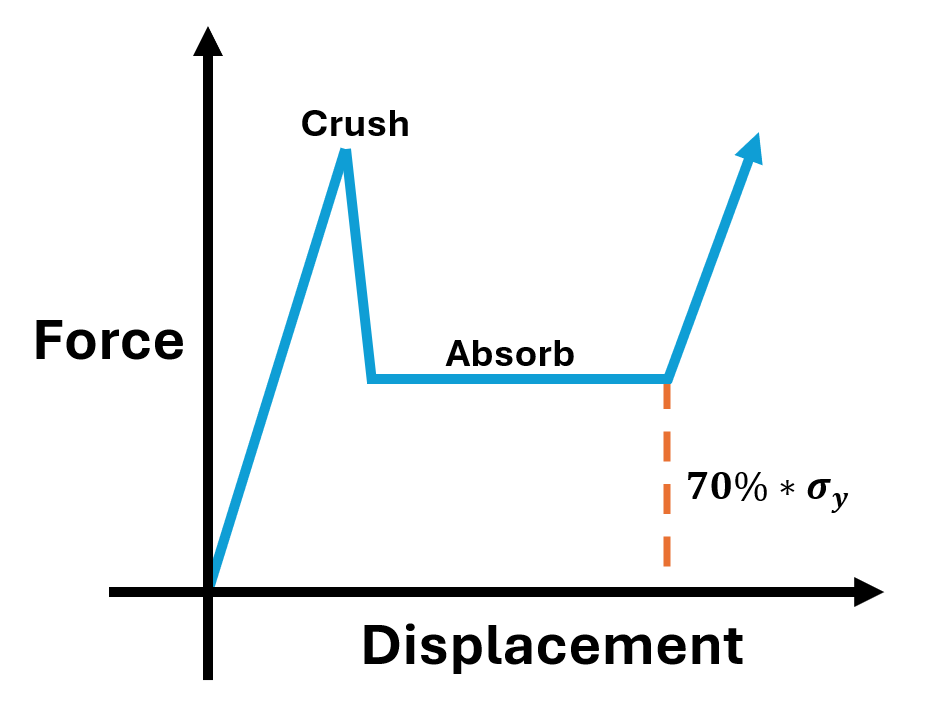
- Core crush - point load across a surface area, progressive but can feel sudden. F = P/A, where A is the surface area of contact. It's more of an avalanching crush of the core.
- Core punch-thru - shear strength in a perimeter is not adequate. F = P/A, where A is the area around the point load. Punch thru is a sudden drop, more like a hole in the ground than an avalanche.
Core crushing typically occurs with elastic deformantion then progressive uniform crimpling until 70% of the original height is met. At this stage the core has failed but energy is still capable of being absorbed.
Vibations in Honeycomb:
- low hz (<50 Hz) - bending is uniform
- mid hz (50-1000 Hz) - transverse shear strain in core
- high hz (1000+ Hz) - skin bending acts as if disconnected
Bolts:
Holes in panels introduces weakening of fracture resistence of 40-60% in tension and 15% in compression. General rules of thumb if hole is failing:
- Tensile hole failure - insufficient number of 0 deg plies.
- Shear hole failure - insufficient number of 45 deg plies.
- Bearing hole failure - insufficient thickness.
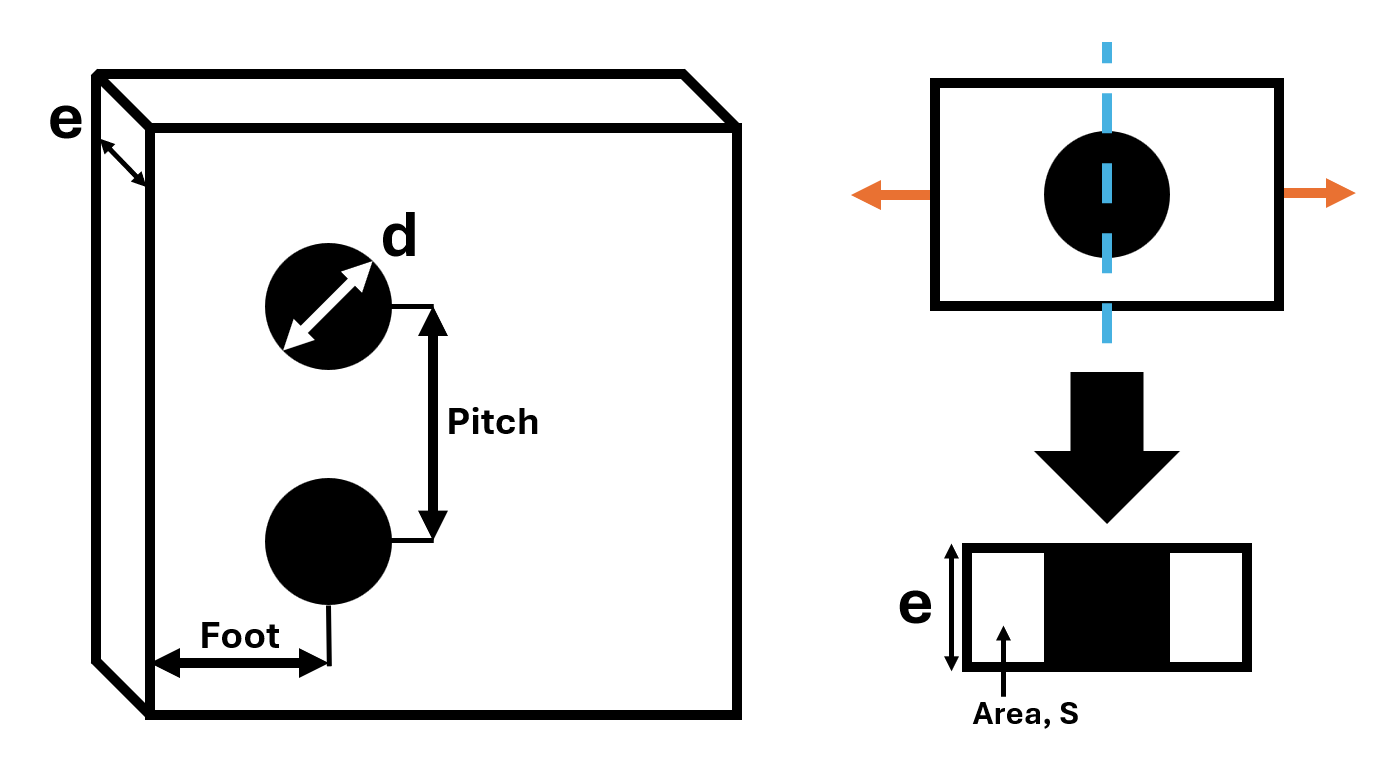
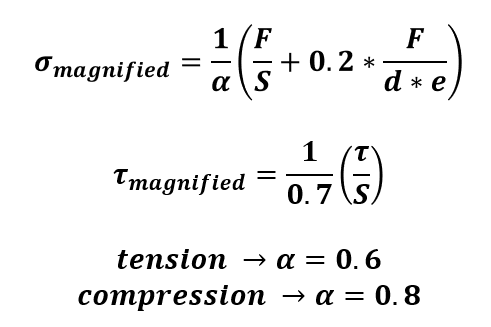
Bearing due to lateral loads is the contact pressure between shaft of bolt and wall; leads to mushrooming and delamination. The resistence of a hole with a bolt is 40% weaker than of empty. Equivalent bearing pressure which leads to crushed walls of hole diameter, d, is F/(d*e) <= admissible stress which is 500 MPa for CFRP. Stress about holes becomes concentrated which magnifies the nominal stress, this stress is depicted using magnified stress formulas.
- 2d distance from free edge
- 4d <= pitch <= 6d
- foot >= 6d
- e >= d/2
- reinforcement at 45 deg recommended
Bolts are subjected to 2 simple loads: bending & shear:
- Tightening of the bolt will lead to a transmission of contact pressure between the support component & the facing.
- ΣF will balance out shear load & suppress the risk of face separation.
- The facing is fragile & cannot permit high contact pressures that are localized under the bolt head & nut, use washers.
- Bolts accompanied by bonding provide a gain of mechanical performance of 20–30%. At the expense of higher weight.
For bonded joints:
- Avoid tension at all cost.
- Joints must work in shear, in-plane.